Web hosting basics
A UK-facing website, a British supplier and a UK server are three different things. Compare performance, billing, support, security, search and payment arrangements, then use a verified entry-budget example to choose the hosting service that fits your business without relying on nationality or unsupported speed claims.
7 min readUK article
 Web hosting basics
Server response is part of the time a customer waits, but it is not the whole page experience. Explore ten practical effects, understand location and latency, and use a controlled investigation to identify whether the problem is the network, application, infrastructure or browser before recommending a fix.
6 min readUK article
 Web hosting basics
NVMe is a way of communicating with storage, while SSD describes the storage device. Learn what that distinction means, where NVMe can help and why storage specifications alone cannot prove faster pages, safer data or a better hosting service for a UK business website.
6 min readUK article
 Affiliate & reseller hosting
Performance affects how easily customers read, navigate and complete tasks. Explore ten reasons to improve it, distinguish business outcomes from assumptions, and use a measured workflow to investigate images, scripts, application work and hosting before choosing the next optimisation.
6 min readUK article
 Affiliate & reseller hosting
An abuse report can concern a compromised website, harmful customer activity or a disputed claim about content. Use a ten-step workflow to verify the report, coordinate proportionate action and document the result, with distinct handling for security incidents, email abuse and rights complaints.
6 min readUK article
 Security & privacy
A hacked website needs an organised response that protects visitors and preserves evidence. Follow thirteen coordinated stages from initial assessment to monitored recovery, with early client involvement, realistic limits on maintenance mode and a separate assessment of any personal-data breach obligations.
6 min readUK article
 Troubleshooting
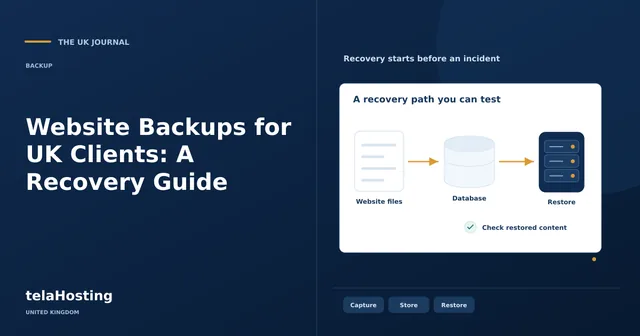
A backup is useful when the business can recover the right information in an acceptable time. Learn how to define coverage, choose retention and storage, distinguish backup methods and run a meaningful restore test, including the extra work needed when malware or recent transactions complicate recovery.
6 min readUK article
 Security & privacy
Malware protection connects prevention, detection and recovery. Review fifteen controls across the hosting platform, client applications and administrator devices, then prepare a response that investigates the cause instead of assuming one scanner or a clean-looking homepage proves the whole account is safe.
6 min readUK article
 Security & privacy
A prevention plan should follow the ways an attacker could reach the website. Map four common entry routes, then review fourteen layers covering the host, accounts and application. This practical UK agency approach reduces exposure while preparing for the possibility that an incident still occurs.
6 min readUK article
 Affiliate & reseller hosting
HTTPS protects the connection between a browser and a website, but its certificate does not certify every business claim or application. Learn how TLS works, what validation types mean and which installation, renewal and testing tasks a UK website owner should manage.
6 min readUK article
 Security & privacy
Website security needs named owners and repeatable checks. Use fourteen practical controls to organise work across the client, agency and hosting provider, covering common threats without assuming that a certificate, plugin or hosting package can guarantee protection against every attack.
6 min readUK article
 Affiliate & reseller hosting
Reseller hosting is an operating model, not a security guarantee. Evaluate the actual platform, client-account separation and maintenance responsibilities through ten focused checks, then build a proportionate risk review that covers the agency, upstream provider and individual websites rather than relying on a trusted logo.
6 min readUK article