
In this article 9 sections
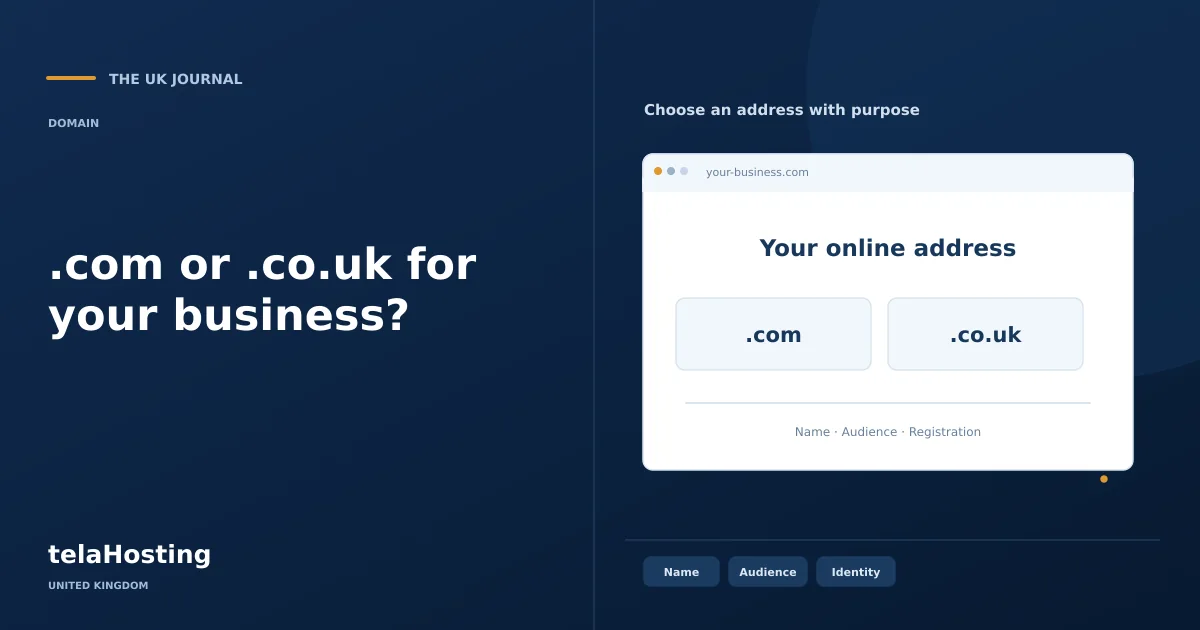
A domain should make it easy for a customer to find you, recognise you and return. For a UK business, both .com and .co.uk can do that job. The useful question is which address best supports your customers and the way you intend to grow.
A local consultancy serving clients across Yorkshire has a different naming problem from a subscription software business selling internationally. Neither should choose an extension solely because somebody calls it better for SEO. Start with the business name, audience and ownership arrangements, then compare the available addresses.
What the two extensions mean
.com is a generic top-level domain. It is widely used by commercial businesses and many other organisations, without identifying a particular country in its ending. A name such as example.com can support an international business, a UK-only business or an organisation that expands later.
.co.uk sits within the United Kingdom's .uk country-code namespace, administered by Nominet. It has a clear association with UK commercial activity. The name example.co.uk has two labels after the business name, but customers generally treat the whole ending as a familiar address.
Neither extension includes a website, mailbox or company registration automatically. You arrange those services separately or through a package that expressly includes them. Registering an address also does not give permission to use somebody else's trade mark.
Compare them against the job your website needs to do
| Decision | .co.uk | .com |
|---|---|---|
| Audience signal | Clearly associated with the UK | No country is specified by the extension |
| Typical commercial use | UK shops, services, practices and agencies | UK or international businesses and products |
| Registry arrangements | Nominet rules and the .uk registration system | The generic-domain registry and registrar system |
| Website and email support | Works with suitable hosting and mail services | Works with suitable hosting and mail services |
| Search visibility | Provides a UK country signal | Can target UK customers through the site's content and other signals |
| Brand protection | Worth considering where the UK version matters | Worth considering where the international version matters |
This table describes the addresses, rather than ranking every possible business. An easy-to-spell name on a suitable extension is usually a stronger practical choice than an awkward name chosen to obtain a particular ending.
When .co.uk is a strong fit
Choose .co.uk when being understood as a UK business helps the customer make a decision. A local retailer can combine it with prices in pounds, accurate delivery information and clear contact details. A professional service can use it alongside the towns or regions it actually serves.
The extension does not prove that a business has a UK office, employs a local team or hosts its servers in Britain. Those are separate claims that should be supported on the website. Use the address as a useful audience signal, then make the actual service details easy to verify.
For a business that expects to remain UK-focused, there is no technical need to buy an international address just to appear established. Consistency across signage, invoices, local listings and branded email is more useful than collecting many domains that nobody maintains.
When .com may suit the brand better
A .com address can be convenient when one product or service will have an international audience. It avoids placing a country name in the extension and can make a single global identity easier to maintain. That is particularly relevant when the company name is distinctive and the exact .com is available.
Do not confuse a global-looking address with a global operating capability. Your website still needs to explain the countries you serve, payment currencies, delivery boundaries and support arrangements. International content may require separate regional pages and language decisions regardless of the extension.
If the exact .com is already used by another business, look at the whole naming problem. A long, confusing variation can be harder to communicate than a clear .co.uk. Avoid choosing a near-identical name that creates confusion or raises a trade-mark issue.
What changes for SEO?
Google's guidance on multi-regional sites explains that country-code domains can provide a country-targeting signal. It does not promise that using .co.uk will outrank a relevant .com page. Search visibility also depends on useful content, crawlable pages, relevant links and the quality of the experience.
A UK business using .com can still explain its UK audience clearly: write appropriate service pages, use accurate geographic information and maintain the business listings it is eligible to use. A .co.uk site should do the same work rather than relying on the extension alone.
If you operate multiple regional sites, decide which content genuinely differs. Copying every page across several addresses without a content and canonical strategy can create avoidable duplication. Use appropriate regional URLs and, where relevant, language annotations. A small UK-only business normally needs one well-maintained website first.
Should you register both?
Owning both can be sensible when the names are important to your brand and the ongoing cost is justified. The normal starting point is to choose one primary website and redirect the alternative to it. Customers then reach the same useful destination whichever address they remember.
Use a proper permanent redirect where the alternative is intended to remain secondary. Do not publish identical copies of the site on both domains without deciding which URLs should be indexed. Make sure HTTPS works on the redirected domain too; a browser may need to establish a secure connection before it can receive the redirect.
Think separately about email. You may want the secondary domain to accept selected aliases or prevent impersonation, but it should not accidentally become an unmonitored inbox. Configure the mail service and authentication records for the way you actually use each domain.
Check costs and control before you register
Compare registration and renewal for the same period, rather than comparing one provider's first-year offer with another's renewal. Also establish what happens when you move the domain, change its contact details or stop using a bundled hosting service. Domain and hosting billing can be independent even when purchased together.
The registrant should be the business or person entitled to control the name. A designer can help with setup without becoming the owner. Keep the account recovery method accessible to the business, use multifactor authentication where available, and record who is responsible for renewals.
At telaHosting UK, the domain price list separates extension pricing, and the domain search lets you check a preferred name. Use the actual extension and period when making a budget; a hosting free-domain offer is a separate, product-specific benefit.
A practical decision process
- Write down the audience you need to serve during the next two or three years.
- Shortlist names that are easy to say, spell and recognise.
- Check the exact .co.uk and .com, relevant trade marks and obvious naming conflicts.
- Choose one primary address and decide whether an alternative is worth protecting.
- Record ownership, renewal responsibility, hosting and mail arrangements.
- Launch with consistent links and test redirects, HTTPS and branded email.
Once the choice is made, use it consistently. Changing your preferred address later is possible, but it affects links, email, search indexing and printed material. A considered decision now avoids treating a domain migration as a last-minute design task.
If you later change the primary address
Prepare a URL map before moving. Each important old page should lead to its relevant new counterpart, rather than sending every visit to the homepage. Update internal links, canonical references, sitemaps, analytics and business listings, and keep the old domain renewed while its redirects are still needed.
Test the website and email as separate projects. A web redirect does not forward a mailbox, and a nameserver change does not automatically migrate messages. Plan the transition around the services the business actually uses so that the new identity is introduced without losing enquiries.
Follow the subject
Your perspective
Join the discussion
Ask a question, share what worked, or add a useful detail.
Loading discussion…
Comment moderation
Only approved contributions appear in the discussion.