

In this article 11 sections
Reseller hosting cost depends on account capacity, storage, features and operating scope. A small agency with a few conventional sites has a different requirement from a business managing many dynamic shops. Compare the allocation and responsibilities before treating a headline charge as the total cost.
This guide uses telaHosting’s public GBP catalogue captured on 30 October 2026. It presents actual plan examples instead of inventing a typical UK market price range. Prices should be identified by their billing basis, and a supplier’s product label should not be mistaken for a technical capability.
Current telaHosting plan examples
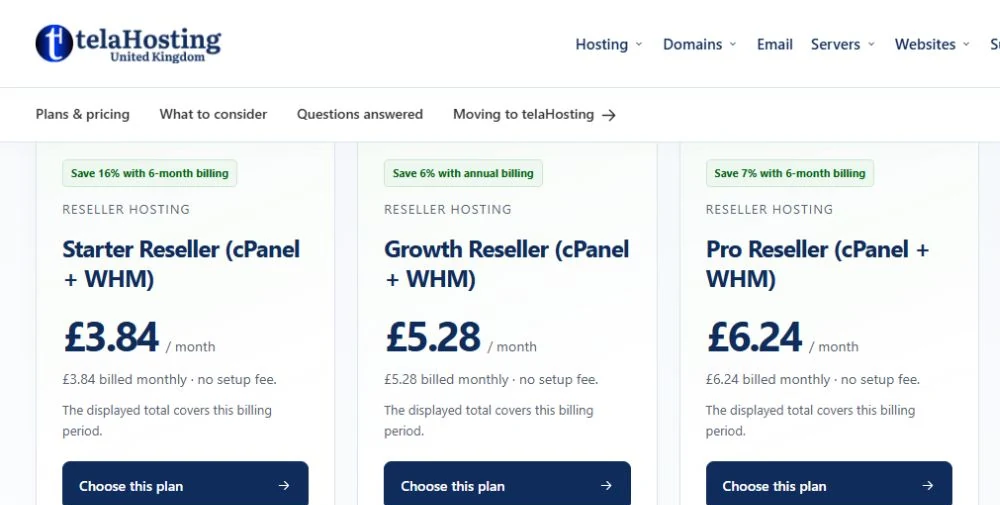
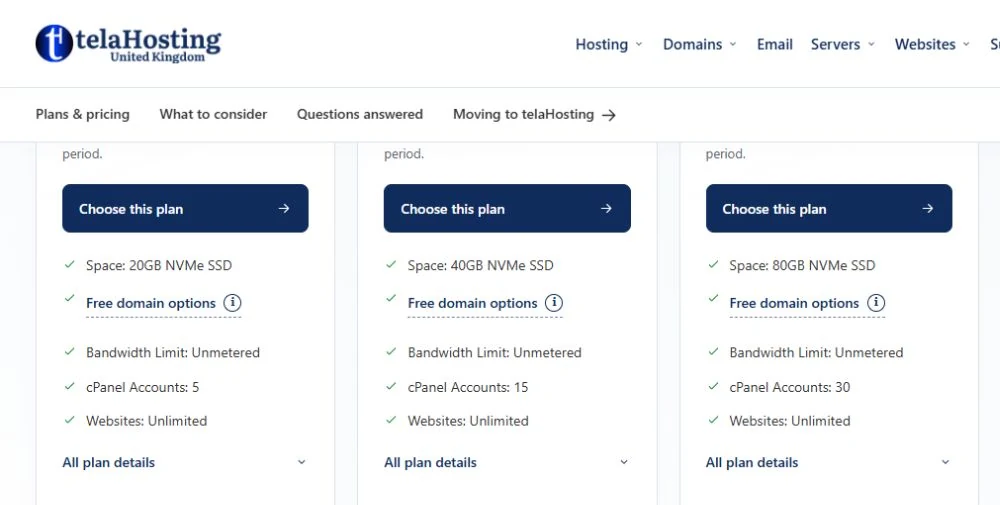
| Plan | Monthly billing | Annual payment | cPanel accounts | NVMe storage |
|---|---|---|---|---|
| Starter Reseller | £3.84/month | £38.40/year | 5 | 20GB |
| Growth Reseller | £5.28/month | £59.52/year | 15 | 40GB |
| Pro Reseller | £6.24/month | £72.00/year | 30 | 80GB |
| Master Reseller | £7.20/month | £82.56/year | 50 | 140GB |
These are listed hosting charges, with the captured catalogue not establishing a VAT basis. The Master name is the supplier’s tier label; it does not by itself establish permission to create sub-resellers. Check the privileges actually supplied before building a business model around that term.
Understand monthly billing and annual equivalents
Starter’s £38.40 annual payment is equivalent to £3.20 a month paid annually. Its monthly invoice option is £3.84. Growth’s annual equivalent is £4.96, Pro’s £6.00 and Master’s £6.88. Keep the initial payment and commitment visible alongside those equivalents.
Annual prepayment can change the charge and cash commitment. Model whether the business can fund it before clients pay and whether the allocation fits the coming period. A nominal discount is not useful if unused capacity or a later migration costs more.
Six factors behind the price and value
Storage: include files, databases, mail and relevant operational overhead. Transfer: read the actual unmetered or bandwidth policy; it does not mean unlimited processing. Account count: separate cPanel slots can be a constraint even when disk remains available.
Location and performance: verify the real server location and workload behaviour rather than inferring them from currency. Support: compare channels, escalation and tasks included. White-label features: check branding and nameserver scope without assuming they convey infrastructure ownership.
Ask about CPU, memory and process limits in addition to the table. A plan’s relative resource label is not an independent benchmark. Measure representative sites and retain headroom for spikes, failures and ordinary growth.
A lower entry-budget comparison
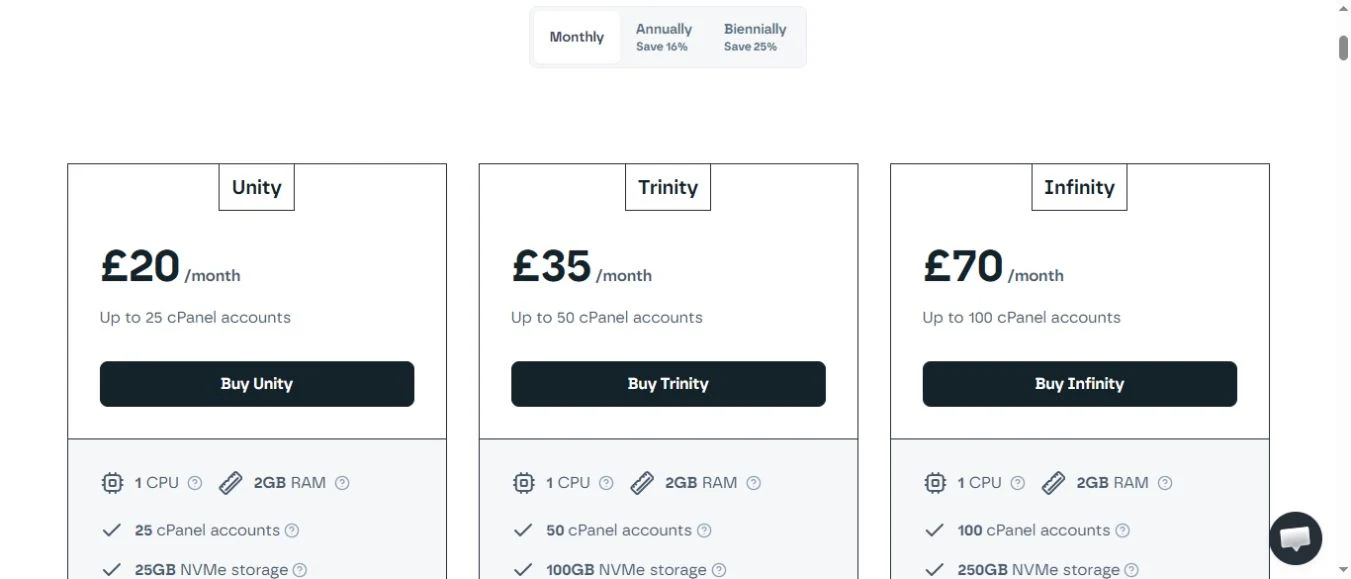
For up to five client accounts, telaHosting Starter Reseller’s £3.84 listed monthly bill is lower than Krystal Unity’s £20/month captured on the same date. Unity includes twenty-five accounts, 25GB NVMe and daily offsite backups, while Starter lists five accounts, 20GB and weekly backups.
The advantage is the smaller initial hosting budget for that scenario. It is not a claim that telaHosting is cheaper per fully occupied account or that the services are equivalent. Use the actual customer count and recovery requirement in the decision.
Budget for costs outside the allocation
Check billing software, payment fees, domains, backup storage, monitoring and any commercial extensions. Confirm software licence scope rather than assuming a panel subscription includes every other product. A free-domain statement is product- and extension-specific; do not infer a .co.uk entitlement.
Include onboarding, migrations, customer questions, updates and incident work. A small infrastructure charge can coexist with substantial support costs. Decide which work is included and which requires a separate quotation so the package remains understandable and sustainable.
Model revenue without assuming full occupancy
In a hypothetical service with five clients paying £12/month, revenue is £60. Subtracting only a £3.84 monthly upstream charge leaves £56.16 before all other costs and tax. That is not net profit or evidence that five customers will buy.
Run a lower-occupancy case and include time. Check what happens when a customer leaves, a refund is due or one site needs an urgent restoration. Keep annual client receipts available to fund the full service term instead of spending them as immediate surplus.
Choose the smallest allocation that fits the service
Count the required separate accounts and estimated workloads, then document the next upgrade trigger. A larger tier may offer useful capacity, but more slots do not create demand. Students and beginners should apply the same calculation rather than assuming a low plan price makes the whole operation effortless.
Do not spend initially on custom infrastructure, elaborate branding or overlapping subscriptions unless they serve a defined need. A clear website, accurate records, secure access and tested recovery are more important than a large catalogue of tools nobody maintains.
Keep a renewal and growth budget
Record upstream billing, software renewals, domain dates and client payment cycles. Reconcile charges and investigate unexpected changes. Preserve the plan description and agreement used when making customer promises.
Review costs as account use and support demand increase. A client portfolio can reach a processing or service-capacity limit before all account slots are sold. Upgrade when evidence shows the need and confirm the migration or allocation-change process.
Use a practical buying checklist
- Does the plan permit the intended resale and supported applications?
- Do account, storage and resource limits fit the initial clients?
- Are backups, restoration and support responsibilities clear?
- Are required software and payment costs included in the budget?
- Can the business fund the billing commitment and continuing service?
- Is there a workable exit and client handover process?
Review the current reseller catalogue with that checklist. The useful cost is the cost of delivering a reliable customer service, with the upstream plan as one clear, evidenced component.
Build a cost worksheet around actual decisions
Give each cost a billing period, an owner and a reason. Separate the upstream allocation from per-client expenses, annual software renewals and labour. Leave an unverified cost marked for investigation rather than inserting a convenient estimate and presenting it as a provider price.
For each planned package, record the supported account count, expected storage and recovery needs. Then identify the cost of delivering that promise at low, expected and high occupancy. A package can reach its support limit before the infrastructure is full, so include the time to answer questions and handle changes.
A break-even formula can be useful when its assumptions are explicit: fixed operating costs divided by contribution per client gives an arithmetic starting point for the number needed to cover those fixed costs. Contribution means the price less the directly attributable costs in that model. It does not automatically include every tax or the owner’s pay.
For example, assumed fixed costs of £30 and an assumed £10 contribution imply three clients to cover those costs. This is a hypothetical illustration, not a market forecast, recommended price or estimate of actual profit. Replace every assumption with evidence from the service being planned.
Keep the worksheet tied to the contract. If backups, support availability or account capacity change, update the delivery cost as well as the sales page. Record the review date and the evidence behind current upstream prices. This makes later package changes easier to explain and helps the business avoid selling a promise whose cost has never been evaluated.
Review the worksheet after the first clients are onboarded. Replace estimated support effort with measured work and check whether the package still covers its promises. Keep the next capacity decision tied to that evidence.
Published plans · 30 October 2026
80.80% lower listed monthly entry bill for a five-account reseller start
An agency beginning with up to five separate cPanel accounts, rather than needing a 25-account allocation immediately.
For an agency starting with up to five cPanel accounts, telaHosting Starter Reseller lists £3.84/month versus Krystal Unity’s £20/month entry plan. That is £16.16 less per listed month, or an 80.80% lower entry bill.
- Krystal includes 25 accounts versus five, 25GB versus 20GB, and daily offsite versus weekly listed backups.
- Do not describe an 80.80% reduction in cost per fully used account; this comparison is the plan entry bill.
- Krystal’s captured Include VAT control is unchecked and telaHosting’s VAT basis is unstated; final invoices are not equated.
Follow the subject
Your perspective
Join the discussion
Ask a question, share what worked, or add a useful detail.
Loading discussion…
Comment moderation
Only approved contributions appear in the discussion.


