
In this article 9 sections
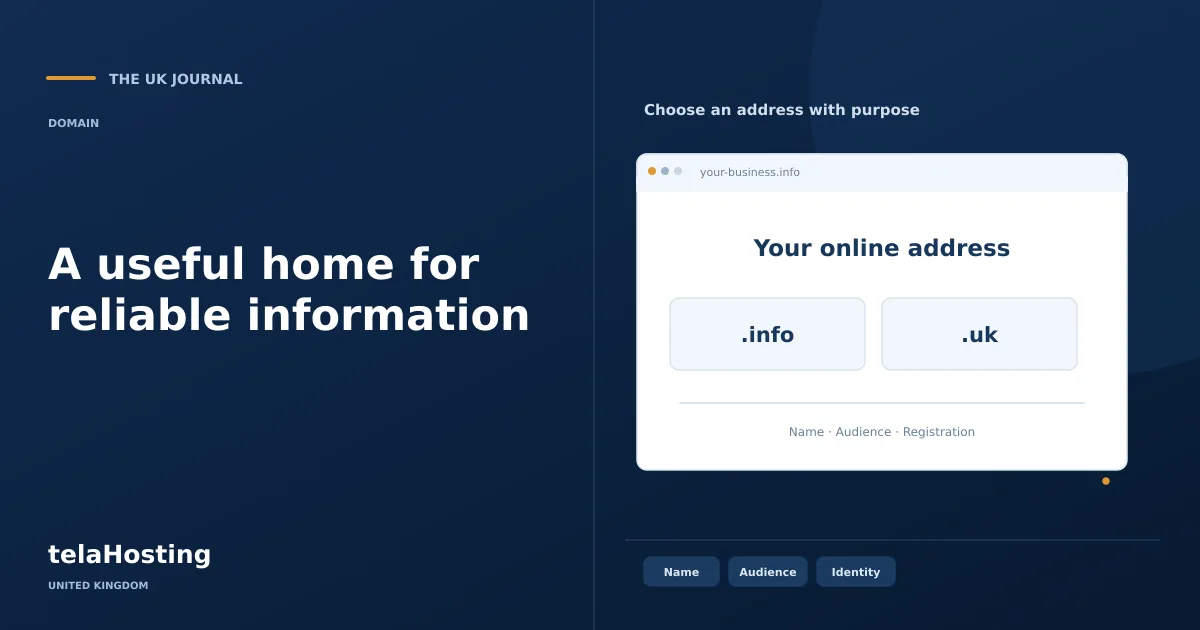
A reference website might explain a local area, publish a specialist guide or help people understand a service. Its domain should make that purpose easy to communicate. Both .info and .uk can be considered, but the extension alone cannot establish accuracy or make the resource useful.
Choose the ending after defining the site's audience and responsibilities. Who is expected to use the information? Who updates it? Could an outdated page cause a reader to make a poor decision? The answers help you build a credible resource, whether its address is descriptive, geographic or brand-led.
What .info and .uk tell a reader
.info is a generic top-level domain. Its wording may suit an information-led project, particularly where the subject is not tied to one country. A concise topic or organisation name can work naturally with it. The domain still needs to be distinctive enough to avoid confusion with another publisher.
.uk is the United Kingdom's country-code top-level domain. It can signal a UK association in a short address. That may be appropriate when the resource explains UK procedures, local services or a place in the UK. It does not prove that the information is official or approved.
The alternatives are not limited to those two endings. A UK commercial publisher might prefer .co.uk, while a not-for-profit project may consider .org.uk. An established organisation may be better served by a section or subdomain of its existing website rather than another independent registration.
A comparison for information publishers
| Criterion | .info | .uk |
|---|---|---|
| Main signal | Information-oriented wording | UK association |
| Geographic scope | No country specified by the extension | Country-code namespace |
| Suitable content | Reference material with a clear publisher and purpose | UK-relevant reference material with a clear publisher and purpose |
| Evidence of authority | Must come from the publisher and content | Must come from the publisher and content |
| Technical services | Website, mail and other services through DNS | Website, mail and other services through DNS |
| Long-term responsibility | Renewal, security and editorial maintenance | Renewal, security and editorial maintenance |
Match the domain to the scope of the information
If every page describes a UK-specific process, a UK address can help communicate that boundary. State the relevant jurisdiction and date in the content as well. A domain cannot explain whether a particular rule applies to England, Scotland, Wales, Northern Ireland or the whole UK.
A global technical reference may find a generic address more flexible. It can still provide separate UK-specific explanations where needed. Resist the temptation to label guidance universal when examples, prices or eligibility rules are actually local.
For a temporary campaign or a small guide within an existing organisation, assess whether a new domain creates more work than value. Another address brings another renewal, another security boundary and another place where ownership can become unclear when staff or volunteers change.
Credibility comes from visible editorial practice
Tell readers who publishes the site, what it covers and how to report a correction. Explain whether a page is a practical guide, a personal opinion, a product comparison or official guidance. That distinction should not depend on the reader recognising a small disclosure in the footer.
Use primary sources for important claims and link directly to the relevant guidance. Record review dates for information that changes, such as pricing, application rules or software procedures. When an old article remains useful, keep its historical context visible instead of simply replacing its date.
Do not present a domain name as evidence of expertise. A clear address can support a credible resource, but the sources, explanations and maintenance demonstrate its value. For specialist legal, medical or financial matters, the editorial process should reflect the seriousness of the subject.
What the extension can and cannot do for SEO
Google's guidance recognises country-code domains as a signal in multi-regional site decisions. This does not mean a .uk page automatically ranks above a .info page for a UK query. A page that gives the right answer clearly still needs to be crawlable, relevant and well connected within the site.
Likewise, .info is not a promise of special treatment for informational searches. Choose titles that describe the actual question answered. Avoid publishing several near-identical pages that repeat a keyword while adding little new information.
Organise related articles into useful topic sections. A beginner should be able to reach an explanation of prerequisites, follow a detailed guide and find the next relevant task. Clear internal linking is more useful than a large cloud of loosely related tags.
Build a maintainable information structure
Give each page a defined purpose and a responsible editor. Separate evergreen explanations from time-sensitive announcements. For example, a guide to understanding DNS can remain useful for years, while a provider-price comparison needs a dated evidence trail and periodic review.
Use headings that reflect the information hierarchy, readable paragraphs and descriptive link text. Provide alternatives for meaningful images and make tables understandable on small screens. A resource that is technically accessible but difficult to navigate still creates unnecessary work for its readers.
Plan how corrections affect related pages. If a policy changes, update the main guide, linked summaries and any comparison table that relies on it. Keeping a small content inventory helps prevent contradictory advice from accumulating across a growing blog.
Registration, renewal and account control
Search for a memorable name, check obvious conflicts and compare the registration and renewal period. Do not treat a first-year promotion as the permanent operating cost. A reference website can be valuable long after its original launch budget has been forgotten.
Use the correct registrant details and an administrator contact that can survive a staff change. Secure the registration account and keep recovery methods current. If a supplier manages the name, make sure the agreement explains the organisation's control and the handover process.
A domain, DNS hosting, website hosting and email can be supplied together or separately. Record the responsibility for each. This makes a later move easier and prevents an unnecessary nameserver change when only a single website record needs updating.
Using both domains
You may decide that a secondary address is worth protecting. Choose one primary website and redirect the other when it is not intended to have distinct content. Ensure the redirect works over HTTPS and leads to relevant pages where an old content structure is being replaced.
If two domains genuinely serve different audiences, write content that reflects those differences. A UK guide should explain the UK context, rather than repeating an international page with only the place name changed. Use canonical and regional-site decisions consistently instead of leaving the search engine to interpret several unmanaged copies.
For a new project, keep the arrangement simple. Launch one clearly identified resource, establish an update routine and expand only when the extra site has a real editorial purpose. More domain registrations do not compensate for missing or unreliable information.
A launch checklist for a useful resource
- Define the audience, geographic scope and subjects covered.
- Choose a name that readers can remember and spell.
- Check naming conflicts and registration arrangements.
- Publish the publisher's identity and a correction route.
- Give important claims primary references and meaningful review dates.
- Test navigation, accessibility, HTTPS and the mobile reading experience.
- Assign renewal and editorial responsibilities before launch.
Use the telaHosting UK domain search to explore offered names, then choose a hosting plan appropriate to the resource. The strongest address is the one you can support with clear information and consistent care.
Follow the subject
Your perspective
Join the discussion
Ask a question, share what worked, or add a useful detail.
Loading discussion…
Comment moderation
Only approved contributions appear in the discussion.