

In this article 12 sections
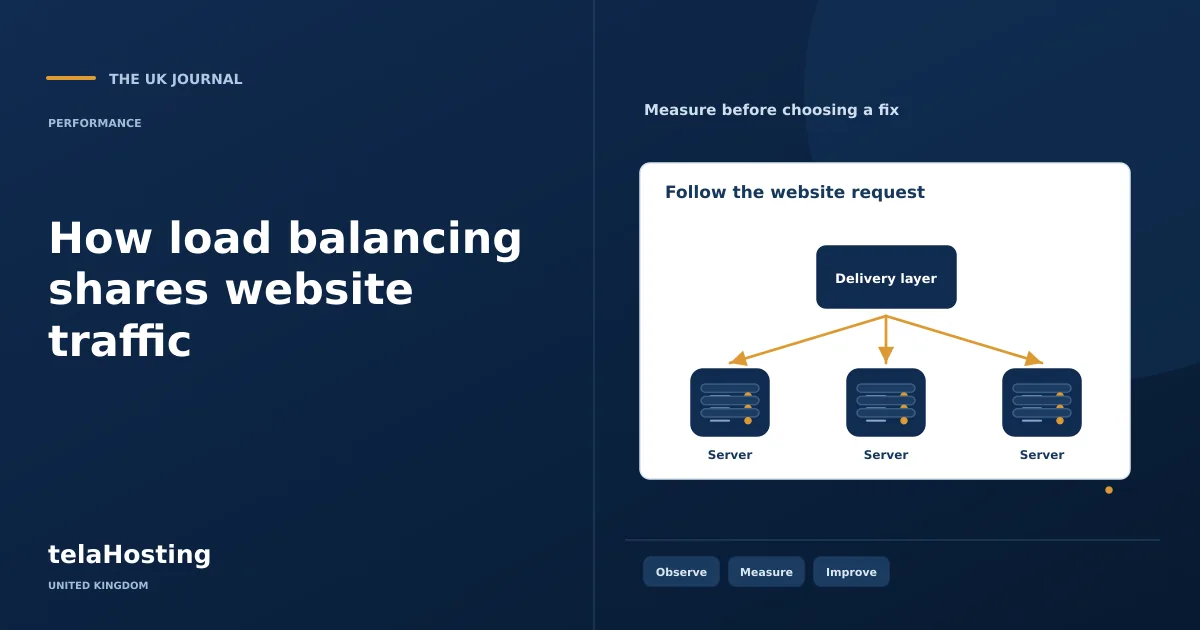
Load balancing distributes incoming work across a group of eligible backends. A visitor uses the website’s public address while a load balancer selects a server or endpoint to handle the request. This can support additional capacity, planned maintenance and recovery from particular backend failures.
The result depends on the whole design. Two web servers that both rely on a failed database will not keep checkout working. A single unprotected load balancer can itself become a failure point. Start by identifying which workload you need to distribute and which dependencies must remain available.
How a request moves through the system
At a high level, the customer’s request reaches a public entry point. The load balancer evaluates its routing policy and available backends, forwards the request and returns the response. Depending on the service, the decision can be made through DNS, at a network connection level or with application-level information such as the hostname or path.
A reverse-proxy HTTP load balancer may terminate a TLS connection, apply permitted request handling and establish a separate connection to the backend. Configure encryption and certificate validation appropriately for both parts. Preserve the correct host and trusted client-address information without accepting arbitrary spoofed headers.
Where load balancing can help
Distributing work can reduce pressure on one web node when the application can run across several. It can let an operator remove a backend for maintenance while others handle traffic. Health checks can direct new requests away from a backend that has become unsuitable.
Those capabilities can improve the service’s resilience and capacity, but they do not guarantee faster responses or prevent every outage. An inefficient query remains inefficient on another node. A saturated shared database, external API failure or incorrect configuration can still affect the entire website.
Security is a separate design concern. Some load-balancing services integrate with WAF, rate-limiting or DDoS controls. The presence of a load balancer alone does not establish those protections. Keep application updates, access controls, origin restrictions and incident procedures in place.
1. Round robin: distribute requests in turn
Round robin rotates requests among eligible backends. It is straightforward and can work well when nodes have similar capacity and requests have broadly comparable cost. Availability checks still matter, otherwise traffic may continue to reach a failed node.
Equal request counts do not necessarily mean equal work. One request may retrieve a cached page while another triggers an expensive report. Measure response times and backend pressure before assuming an even sequence has achieved a useful balance.
2. Least connections: consider active work
A least-connections policy selects a backend according to the number of active connections, with implementation details varying by product. It can suit workloads where connections remain open for different lengths of time. Weights may also be available to account for nodes of different capacity.
A connection count remains an imperfect measure of processing cost. Modern connection reuse and multiplexing can also affect the relationship between connections and requests. Understand what the product counts and test it with a workload representative of your application.
3. IP hash: route consistently from a client address
IP-hash approaches use the client IP address to make a repeatable backend selection. This may provide a form of affinity, but it is not the same as a robust shared-session design. Network address translation can put many people behind one public IP, and a mobile visitor’s address can change.
Review how the load balancer sees the client address when another proxy sits in front. If every request appears to come from the proxy, the intended distribution can fail. Configure trusted forwarding information using the service documentation rather than trusting an unrestricted request header.
4. Geographic steering: choose an appropriate region
Geographic policies direct traffic according to a location rule or related steering information. They can help an international service place visitors near a suitable regional deployment. Actual latency depends on network routes and service health, so geography alone is not a complete performance measurement.
Regional applications need a data strategy. Decide where writes happen, how content and uploads are replicated, and what customers see during a regional failure. Consider applicable data-protection and transfer requirements. Selecting a region in a routing panel does not settle those operational or legal questions.
5. Weighted routing: reflect differing capacity
Weights let one backend receive a larger share of work than another. They can reflect different resource allocations or support a gradual rollout. A small percentage directed to a new version can help an operator observe its behaviour before increasing exposure.
Weights are a policy choice, not proof of safe capacity. Verify the actual implementation, monitor the new group and define stop conditions. If the smaller node receives disproportionately expensive requests, its nominal share may still be too high.
Choose a policy for the application
| Situation | Potential starting point | Important check |
|---|---|---|
| Similar nodes and short, comparable requests | Round robin | Health and real request cost |
| Long-lived or uneven connections | Least connections | How the service counts work |
| A legacy affinity requirement | Documented persistence or hash option | Session recovery and uneven client groups |
| Several regional deployments | Suitable geographic or latency-aware steering | Data consistency and failover |
| Unequal node capacity or staged rollout | Weighted policy | Measured pressure and rollback criteria |
Product features differ, including which policies require a particular edition or plan. Use current documentation for the selected service. Avoid copying a configuration from another product because it uses a similar method name.
Prepare sessions, files and background work
Multiple web nodes should not depend on an unshared local upload directory if visitors can reach any node. Use a suitable shared or object-storage approach and test access permissions. Keep application code and configuration consistent through repeatable deployment.
Sessions and caches need an explicit design. Affinity can support some applications, but the loss of a node may still lose local state. Background jobs and scheduled tasks must not run twice unintentionally when the number of web nodes increases. Use the platform’s supported locking or queue mechanism.
Use health checks and graceful removal
A health check should identify whether a backend can serve the intended function without exposing sensitive information. Set sensible timeouts and failure thresholds to avoid unstable flapping. Consider the difference between an instance being alive and the application being ready for traffic.
Drain connections before removing or replacing a node where the service supports it. Test a backend failure, recovery and deployment under controlled conditions. Keep monitoring on the load balancer, backends and shared dependencies so the selected route can be explained during an incident.
Discuss hosting requirements precisely
If you are considering telaHosting VPS services, describe the required architecture, management responsibility and application behaviour before assuming a load balancer is included. A single VPS allocation does not establish a managed multi-node service.
Ask about supported connectivity, resource needs and the tasks your team must operate. Start with a tested design and measured bottleneck. Load balancing is useful when it solves that specific problem and the rest of the website is prepared to use it.
Review a failure as a customer would experience it
In a controlled test, remove one backend from service and follow a real task through the public entry point. Check whether an existing session survives, a file remains available and a payment notification reaches the intended application. Record new requests separately from connections already in progress. Then restore the backend and verify readiness before it receives traffic again. This turns a load-balancing configuration into evidence about the particular failure it is meant to handle.
Follow the subject
Your perspective
Join the discussion
Ask a question, share what worked, or add a useful detail.
Loading discussion…
Comment moderation
Only approved contributions appear in the discussion.