
In this article 8 sections
A technology business might be drawn to a domain ending in “net”. It sounds related to networking and may be available when the preferred .com is taken. However, .net and .net.uk are not interchangeable products with the same registration rules.
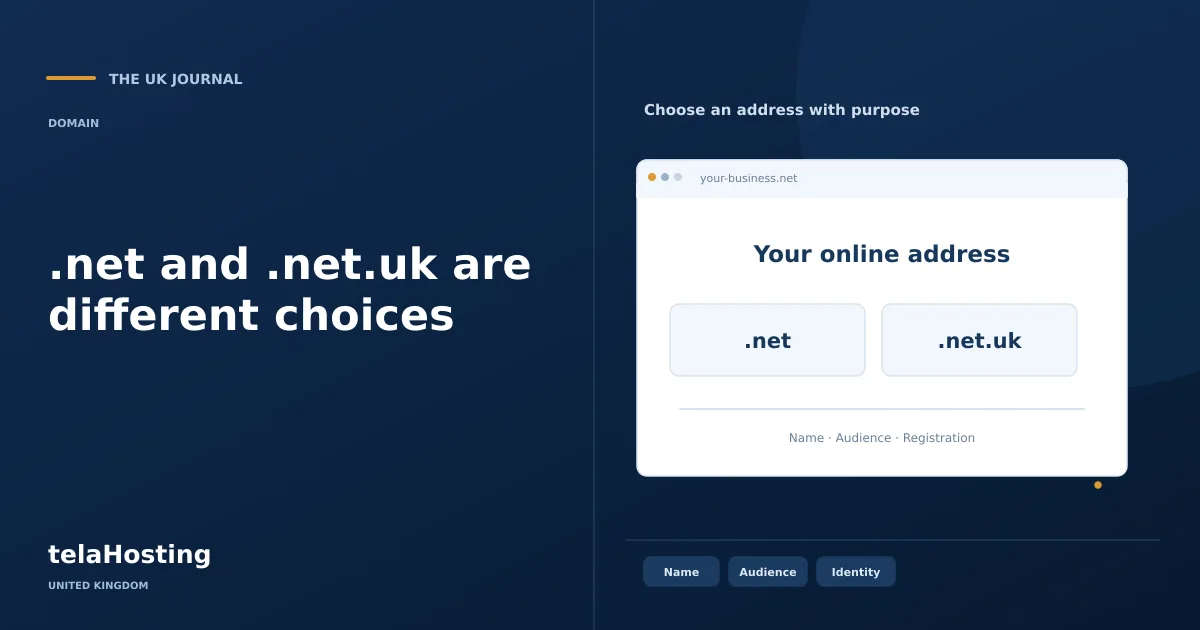
The practical distinction is eligibility. A normal .net is a generic top-level domain used by many kinds of organisation. The .net.uk namespace has specific restrictions associated with internet service providers and their network infrastructure. A software company should not assume that working online automatically makes it eligible.
Start with the naming structure
In example.net, .net is the top-level domain. In example.net.uk, .uk is the country-code top-level domain and .net is a category within it. The complete ending carries both a UK association and a more specific intended use.
Both names can technically be connected to websites, email and other services using DNS. That technical capability does not override registration requirements. Being able to enter a name into a search tool is different from being entitled to register and use it.
| Question | .net | .net.uk |
|---|---|---|
| Namespace | Generic top-level domain | Part of the .uk namespace |
| Typical audience signal | International, with an association people may make with networks or technology | UK network-provider infrastructure |
| Ordinary commercial use | Commonly available through domain-registration services | Subject to specific eligibility and use restrictions |
| Hosting compatibility | Can use suitable web and email hosting | Can use suitable services where registration and use are permitted |
| Proof of security | The extension alone does not prove security | Restricted registration does not replace security controls |
What .net.uk eligibility means in practice
Nominet's current rules reserve .net.uk for defined infrastructure uses by network providers and require the registrant to be an internet service provider. The rules also address the relationship between the domain name and the applicant's name. Read the operative policy with the registration provider before making a commitment.
A digital agency, freelance developer, online shop or SaaS startup is not necessarily an ISP. Registering a company with a technology-related description is not a shortcut around the namespace rules. If .net.uk is being proposed for your organisation, ask which requirement you meet and what evidence is needed.
Policy timing matters. Nominet has announced standardisation changes scheduled for 9 February 2027. This guide is reviewed on 30 October 2026 and should not be read as applying future rules early. An application must be assessed against the rules that are actually in force when it is made.
When .net can be a useful commercial address
A distinctive .net name can suit a technology product, a developer community or a business whose chosen name works well with that ending. It is also an option when you cannot obtain the exact .com without making the address difficult to spell.
There is a branding trade-off: someone who remembers only the business name may try .com first. Before choosing .net, look at what exists on the corresponding .com and whether confusion would affect enquiries. The issue is customer navigation and naming rights, rather than an automatic technical disadvantage.
Do not choose a confusing variation of an established business simply because it is available. Check relevant UK trade marks and the wider context of the name. Domain availability is not a legal clearance service, and buying an address does not remove existing rights.
Should a UK business use .co.uk instead?
For an ordinary UK commercial website, .co.uk or direct .uk may be a more straightforward choice than a restricted extension. They communicate a UK association without implying that the organisation operates network infrastructure. This can be useful for a consultancy, local service or UK-focused online shop.
A sensible shortlist might therefore include the exact business name on .co.uk, .uk, .com and .net. Compare readability, customer expectations, availability and the ongoing cost of the names you would genuinely maintain. There is no requirement to acquire every variation.
Where the exact name is unavailable, a short descriptive addition can work better than a string of hyphens or altered spellings. Say the full address aloud and ask another person to write it down. That simple test often reveals a practical problem before money is spent.
Search visibility: avoid extension myths
A .net website can rank for UK searches when its pages are relevant and useful to UK readers. A .uk country-code domain can contribute a geographic signal, but that does not guarantee a higher position. Google documents several signals and choices for multi-regional websites; a domain ending is only part of the picture.
Likewise, using “net” does not give a technology website an automatic ranking advantage. Useful service descriptions, clear page titles, crawlable navigation, accessible content and relevant references remain important. Choose a name you can build a credible website around.
If you own more than one extension, decide which website is primary. Redirect an unused alternative appropriately rather than publishing an unmanaged copy of every page. Multiple domains are an operational responsibility, not a search strategy by themselves.
DNS and hosting work independently of the label
The hosting provider supplies the destination for the website. The domain's authoritative DNS then points the appropriate names to that destination. An A record normally provides an IPv4 address, an AAAA record an IPv6 address, and a CNAME aliases one name to another where supported.
Email has its own records. MX selects the receiving service; TXT records may publish domain verification and email-authentication information. Changing a web address record should not be treated as permission to replace the mail configuration. Keep a copy of the existing zone before a change.
Ask whether a proposed move changes nameservers or only individual records. A nameserver change delegates the whole zone to a different DNS service. Unless the records are recreated there, the website, mail and other services can be affected together.
Ownership, security and support
Put the registration under the correct organisation or entitled individual, not an agency employee's personal account. Maintain an accessible contact address and a record of renewal responsibility. Protect the account with a strong unique password and multifactor authentication where available.
Check how the registration service handles renewal, transfer, contact updates and support. Do not assume that the same transfer procedure applies to .net and a .uk name: generic domains and .uk registrations use different systems. Follow the process for the exact extension.
DNSSEC can add validation to DNS answers when correctly supported and configured. It does not encrypt the website, prevent every form of phishing or replace HTTPS. Ask your DNS provider how it manages signing and delegation changes rather than enabling an unfamiliar setting during an urgent migration.
Your final shortlist
- Confirm the extension is available for your intended organisation and use.
- Check naming conflicts and whether customers could confuse the address with another business.
- Compare the exact registration and renewal period.
- Choose one primary address and document any defensive registrations.
- Plan website, mail, DNS and account access separately.
- Test the published website and mail from outside the administrator's own connection.
The telaHosting UK domain search is a starting point for generally offered extensions. For a restricted namespace such as .net.uk, establish the registration route and eligibility first. A name that fits the rules and is easy to use is a stronger business asset than an extension chosen on assumption.
Follow the subject
Your perspective
Join the discussion
Ask a question, share what worked, or add a useful detail.
Loading discussion…
Comment moderation
Only approved contributions appear in the discussion.