


In this article 13 sections
Shared hosting usually gives a website owner an account for their permitted sites. Reseller hosting gives a business an allocation and tools to manage client accounts. They can rely on shared infrastructure, so the difference is not simply “shared server versus private server”.
The right choice follows who owns the sites, who needs access and what service you intend to provide. A single business website and several unrelated clients have different account-management needs even when their total storage is similar.
1. Purpose: your project or a customer service
Shared hosting can suit a business running its own brochure site, blog or supported shop within the plan’s resources. Reseller hosting suits someone supplying separate services to clients or managing a portfolio that benefits from account separation.
Do not buy reseller hosting only because an article describes recurring income. It creates responsibilities for billing, support, access and renewals. If those functions are unnecessary, a simpler account may be more useful.
2. Control and flexibility
Both products offer the functions the provider permits. A shared account may manage its websites, databases and mail. A reseller may receive package and owned-account controls through WHM or another panel.
Neither automatically grants root access or arbitrary operating-system changes. If an application needs a custom service or runtime, verify support directly. More customer-management options do not establish unrestricted server control.
3. Account separation
A reseller arrangement can give clients separate cPanel accounts, credentials and allocated limits. This helps organise access and handover. Housing unrelated customers under one shared login makes it harder to give one client appropriate access without exposing others.
Separate accounts still operate within the infrastructure and plan’s policies. They are not proof of dedicated hardware or protection from every fault. Review resource isolation, permissions and recovery at the actual service level.
4. Price and the business model
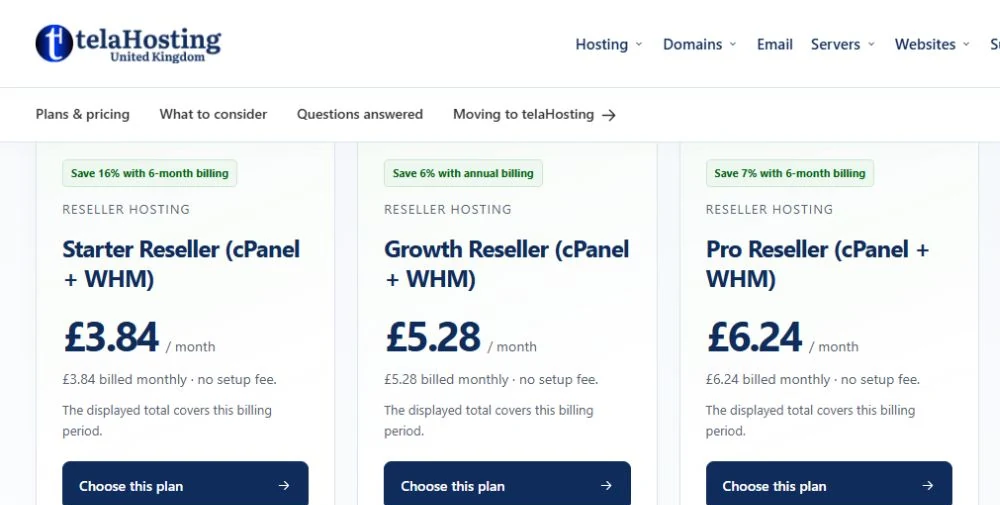
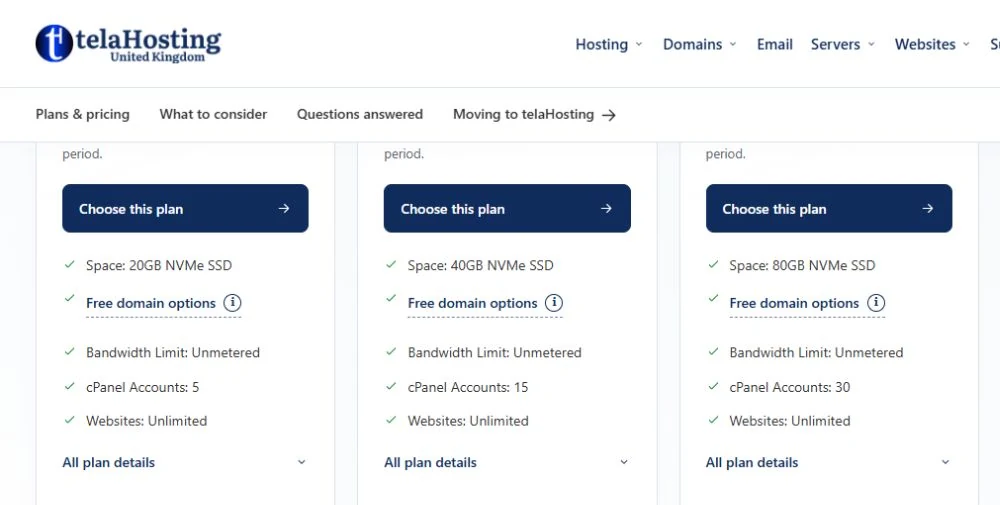
In the catalogue reviewed on 30 October 2026, telaHosting Starter cPanel lists £0.96 billed monthly, one website and 10GB NVMe. Starter Reseller lists £3.84 billed monthly, five cPanel accounts and 20GB NVMe. Those figures describe different products and should be assessed against their purpose.
The reseller can charge clients for an agreed service, but revenue is not guaranteed. Include billing tools, payment fees, recovery arrangements and support time in the calculation. A lower upstream cost does not make every proposed client price sustainable.
5. Ease of use and learning
A shared account can provide a simpler starting point for one owner. A reseller needs to understand packages, account creation, limits, DNS and client permissions as well as ordinary site operation. The panel reduces repeated administration but cannot replace that knowledge.
Use test accounts and official documentation before managing live customers. Learn how to identify an application fault, hosting limit and external-service issue. A customer needs a responsible route to resolution even when the reseller escalates infrastructure work.
6. Support and responsibility
A direct shared-hosting customer normally has its provider relationship for the contracted service. In a reseller arrangement, the client contracts with the reseller, who handles the promised support and escalates upstream issues under a separate agreement.
Define who maintains applications, performs restores and communicates during an incident. Avoid silently selling development or unlimited support as if it were a standard control-panel feature. The customer agreement should match the operation.
7. Performance and reliability
Neither label proves one service is faster or more reliable. Resource limits, workload, application code and shared dependencies matter. A busy dynamic shop can need more capacity than several cached brochure sites.
Compare representative journeys and examine real resource evidence. Ask about backups, restoration and incident handling. Storage allowances and supplier availability claims are not independent benchmark results.
Compare the arrangement directly
| Question | Shared hosting | Reseller hosting |
|---|---|---|
| Typical purpose | An owner’s permitted site or sites | Managing separate client services |
| Account tools | Functions within the individual account | Provider-granted package and client-account functions |
| Customer billing | Owner pays its provider | Reseller also manages client charges and renewals |
| Server control | Limited by the service | Also limited; root is not implied |
| Capacity decision | Actual website workload | Workloads plus allocation and account count |
Choose shared hosting for a straightforward ownership need
A sole trader with one service site may need ordinary hosting, a domain, email and a maintenance process. A personal publisher may also prefer a simpler relationship. Check the supported software, account limits and recovery requirements for the project.
Several sites owned by one organisation still need a considered access design. A shared plan permitting multiple sites can be appropriate in some circumstances, but related ownership does not remove the need for security and backup planning.
Choose reseller hosting for a defined client service
An agency supporting several unrelated businesses may benefit from individual accounts and repeatable packages. In a hypothetical four-client portfolio, separate credentials and resource records can make handover and triage clearer than one shared login.
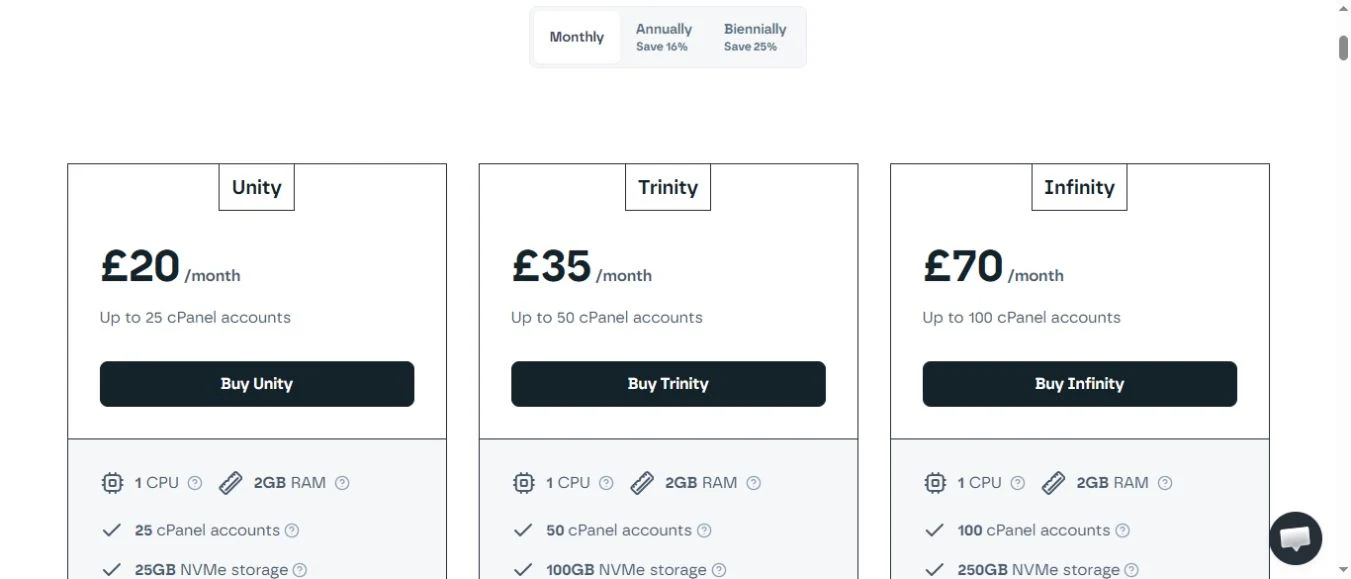
For a small initial account requirement, telaHosting Starter Reseller’s £3.84 listed monthly bill is lower than Krystal Unity’s £20/month, reviewed on the same date. Unity includes twenty-five accounts, 25GB and daily offsite backups versus five accounts, 20GB and weekly backups. This is an entry-budget advantage, not an equal-allocation or tax-inclusive comparison.
Check the whole lifecycle before deciding
Record who owns each site and domain, who can access it, how renewals are billed and how a customer leaves. Test backups and a controlled restoration. Review data roles and supplier arrangements when hosting personal information for clients.
Visit the current shared hosting and reseller hosting pages with those requirements. Choose the product that supports the management relationship and measured workload. The most useful plan is the one the business can operate clearly and consistently.
Work through three ownership scenarios
One owner, one modest site: a direct shared-hosting account may provide the necessary functions with a simple provider relationship. Confirm application support, storage and backup needs, then avoid adding a reseller layer that serves no clear purpose.
Several sites owned by one organisation: assess permissions, workloads and recovery separately. A multi-site shared plan may be allowed, but the organisation may still prefer account separation for different teams. The choice depends on its access and maintenance model, not only the number of domains.
Unrelated paying clients: separate accounts and a permitted reseller arrangement can make access and exit easier to manage. The reseller needs clear client terms, support triage and a process for exporting each customer’s information without exposing another customer.
These are illustrative arrangements rather than universal recommendations. A high-demand site can outgrow an allocation whichever category it belongs to. Record expected dynamic work, mail use and data-recovery requirements before selecting capacity.
If moving from one shared account into separate accounts, inventory files, databases, users, DNS, mail and integrations first. Test each destination and plan how new data is handled during cutover. Do not delete the original account until the migration and recovery checks are complete. Account separation is useful only when the transition preserves the service customers rely on.
Keep the decision record with the account inventory. Note which sites share a login, which have separate ownership and how backups are restored. Review it after a new client or application is added. A clear inventory prevents an earlier convenient arrangement becoming an undocumented access problem as the portfolio grows.
Published plans · 30 October 2026
80.80% lower listed monthly entry bill for a five-account reseller start
An agency beginning with up to five separate cPanel accounts, rather than needing a 25-account allocation immediately.
For an agency starting with up to five cPanel accounts, telaHosting Starter Reseller lists £3.84/month versus Krystal Unity’s £20/month entry plan. That is £16.16 less per listed month, or an 80.80% lower entry bill.
- Krystal includes 25 accounts versus five, 25GB versus 20GB, and daily offsite versus weekly listed backups.
- Do not describe an 80.80% reduction in cost per fully used account; this comparison is the plan entry bill.
- Krystal’s captured Include VAT control is unchecked and telaHosting’s VAT basis is unstated; final invoices are not equated.
Follow the subject
Your perspective
Join the discussion
Ask a question, share what worked, or add a useful detail.
Loading discussion…
Comment moderation
Only approved contributions appear in the discussion.