
In this article 10 sections
If your business uses .uk or .co.uk, Nominet is part of the infrastructure behind that address. Understanding its role helps you distinguish a domain-registration issue from a hosting fault, find the right support contact and avoid treating every supplier as interchangeable.
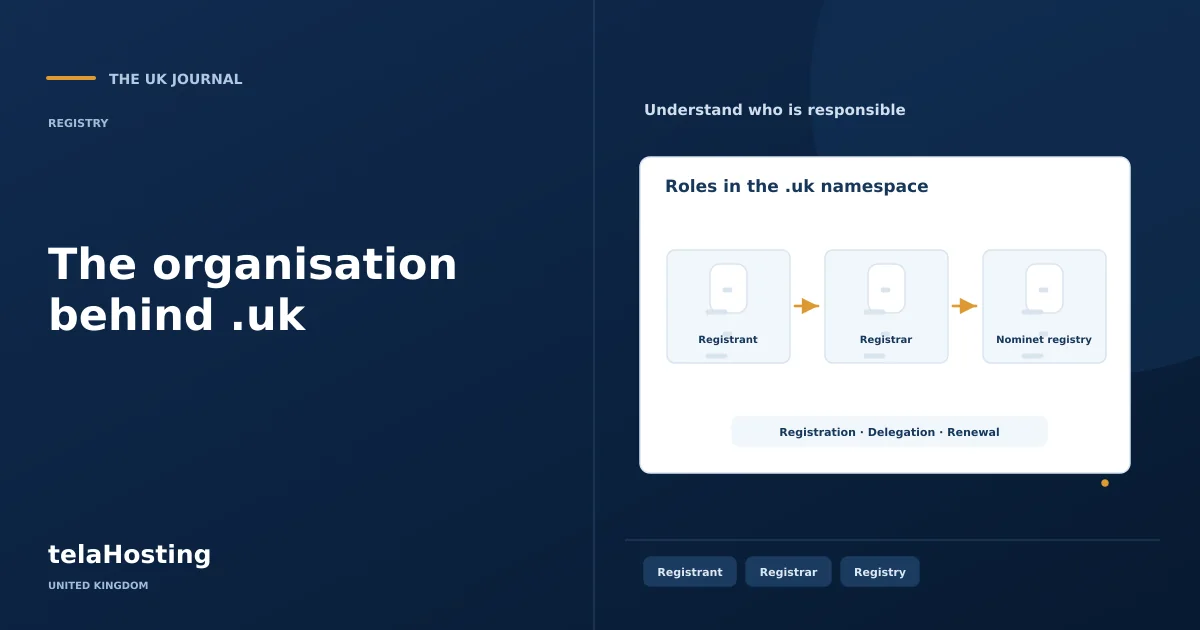
Nominet operates the .UK registry. A registrar is the provider that arranges and manages registrations for customers; the registrant is the person or organisation holding the registration. Your web host may also sell domains, but hosting the website is a separate function.
The registry, registrar and registrant
| Role | What it means | Your practical connection |
|---|---|---|
| Registry | Operates the namespace's central registration infrastructure | Nominet for the .UK family it manages |
| Registrar | Arranges registration and ongoing management | Your usual first contact for domain support |
| Reseller | Sells domain services through an underlying registrar | May be the business whose account and invoice you use |
| Registrant | The named holder of the registration | You or the appropriate legal organisation |
| DNS or hosting provider | Runs authoritative records or website services | May be independent of the registrar |
A supplier can occupy more than one role. That does not make the roles identical. When a problem arises, identify whether it concerns registration data, delegation, DNS answers, a server or an application before changing services.
1. Nominet operates registration infrastructure
The registry maintains the central system for registered names in its namespace. Registration, renewal and registrar-management processes depend on that system. It also supports the delegation information that helps DNS resolvers find a domain's authoritative nameservers.
This does not mean Nominet stores every website or runs every customer's mailboxes. A .co.uk website can be hosted by many different providers. Its authoritative DNS may be operated by the registrar, the host or a specialist DNS platform.
For a business owner, the useful question is who operates each layer. Record your registrar, active nameservers, web host and mail provider. This is much more actionable than describing them all as the company that owns the domain.
2. It establishes rules for its namespace
Nominet publishes registration policies and contractual requirements for .UK domains. They cover matters such as the relationship with registrants and registrars and the permitted use of particular parts of the namespace.
Extensions within the wider UK naming system are not all unrestricted substitutes. .co.uk and direct .uk serve broad uses, while .me.uk has natural-person requirements and .net.uk has restricted infrastructure purposes under the current rules. Government and academic namespaces have their own controlled routes.
Read the rules for the actual suffix before buying a name. The presence of a search box or an available result does not prove that an applicant satisfies restricted-domain requirements or has the right to use someone else's brand.
3. It works with a registrar ecosystem
Nominet publishes a list of registrars showing their TAGs and other information, including accreditation status. Use the official list to verify the actual legal entity rather than assuming a trading name or a domain seller's logo proves a particular relationship.
A retail seller may operate through an underlying registrar. Ask which company is responsible at registry level and how account changes, renewal and support are handled. A clear reseller arrangement is different from an unsupported claim of direct accreditation.
Use telaHosting's domain service to investigate a registration and clarify the underlying registrar and management arrangements. Check the actual legal entity and relationship against the relevant official information rather than inferring accreditation from a retail brand or a hosting package.
4. It provides domain information and support routes
Nominet's Lookup tool can help identify information about an existing domain, including its registrar. Public output does not necessarily reveal every registrant contact detail. Data protection and registry disclosure policies affect what information is available.
For routine management, Nominet recommends using your registrar. Begin there for renewal, nameserver settings, contact updates or access to the account. If you no longer know the registrar, use the official lookup route rather than guessing from the website's footer.
For a record discrepancy, provide the exact domain, the setting involved and evidence of the issue. A browser screenshot of an unavailable page is useful context, but it cannot by itself show whether registration, DNS or hosting caused the fault.
5. It supports security and abuse handling
Nominet describes security and anti-abuse work within .UK, including Domain Watch and cooperation with law enforcement. Registry-level measures form part of the wider ecosystem; they do not replace the registrant's own account and service security.
Protect the registrar and DNS accounts with strong credentials and available multifactor authentication. Keep recovery methods current and restrict who can approve changes. A person with access to domain controls may be able to affect the website and email together.
DNSSEC is another distinct layer. It helps validate signed DNS data when configured correctly. HTTPS, secure applications and mail authentication still need their own setup. No extension or registry relationship makes a website automatically safe.
6. It provides a domain-dispute process
Nominet's Dispute Resolution Service concerns eligible .UK domain disputes. Since 7 July 2026, WIPO administers the service and new complaints go through WIPO, while Nominet’s DRS policy remains the relevant framework. The current official guidance explains who may complain and the stages involved. A relevant right in a similar name and the applicable policy tests matter; a desired domain is not automatically owed to a business because it wants it.
Before registering, check names and relevant trade marks. Domain availability is a technical registration result, not clearance of intellectual-property rights. If a dispute exists, keep evidence and follow the official process or obtain advice appropriate to the situation.
A broken website or poor hosting service is a different kind of dispute. Send the complaint to the relevant supplier rather than assuming the domain-dispute procedure covers every commercial disagreement connected with a website.
Renewal remains your responsibility
Keep the registration active through your registrar. Record the expiry date and renewal arrangement, maintain current payment details and make sure notices reach an address you monitor. Do not rely on a single employee remembering an annual task.
The current Nominet renewal guidance, reviewed on 30 October 2026, allows renewal until 90 days after expiry and specifies deletion at the expiry timestamp plus 95 days. Service disruption can occur earlier, so this is a recovery framework, not a sensible target for routine renewal.
Check account arrangements after moving providers. An old automatic renewal setting or payment mandate should not be assumed to carry into a new account. Confirm the domain and date in the new provider's records.
Current rules and announced future changes
Nominet has announced .uk standardisation for 9 February 2027. On this article's review date, that is a future change. Ordinary .uk registrar changes still use the current TAG-based route; do not follow a future transfer-code procedure as though it already applies.
If you are planning a later migration, recheck the official instructions at that time. The reliable habit is to consult the current registry and registrar guidance for the specific task and date, while retaining control of your organisation's accounts and records.
Keep a practical domain record
Record the exact domain, registrant, registrar, DNS operator, renewal date and recovery contact together. Include which account controls each layer and who is authorised to approve a change. Review that record when a colleague, supplier or legal organisation changes. This small administrative task gives a business a clearer route to help than starting from an old invoice during an outage.
Follow the subject
Your perspective
Join the discussion
Ask a question, share what worked, or add a useful detail.
Loading discussion…
Comment moderation
Only approved contributions appear in the discussion.